2083 VR

ROLE
Solo developper: Narrative, Game and Level Designer
DESCRIPTION
Based on my published novel, I had the opportunity to transform this story into a video game prototype during my studies at Gaming Campus. This production ranged from writing the Game Design Document to developing a fully functional prototype that can be enjoyed as the tutorial for the game.
2083 VR is a very ambitious project that aims at simulating a post-apocalyptic life in France, influenced by Roadside Picnic from Arkadi and Boris Strugatsky.
YEAR OF PRODUCTION
2025-2026
TYPE
Single Player FPS-RPG VR with survival elements
PLATFORM
PCVR (Oculus Quest, PICO, HTC VIVE, SteamVR)
INTELLECTUAL RIGHTS
Owned


2083 VR IN A FEW WORDS
And you, what would you do if it was the end of the world?
The whole of Europe, a now desolate and energy-lacking continent, is watching you! Experience in VR a world where the fall of civilization happened and where a portion of survivors chose to become Walkers, nomadic people striving to find food and safe places to live.
Join thousands of these Walkers seeking out glory, valuables, land, and petrol in the Perimeter - a high-wall sealed-off French region closed by the then-existing French government, in 2074, to protect a military grade industrious mega-complex. Maybe you'll even find the Singularity, an infinite energy device and the last hope for a peaceful continent.
How far are you willing to go to survive ? Fight, join or commerce with the numerous warring factions living inside this quarantine zone: the Coyotes, mercenaries from the flagless wars, the Fanatics, believers led by the Bishop for his holy quest, the Baron's men, warriors made by the Perimeter's fires, or stay loyal to your clan, the Walkers, survivors coming from all over the old continent.
This is your story, and you decide how it goes: will you be a survival expert or be a political animal? Is wealth more important than glory to you? Would you start a war to break a peace agreement?
Will you hear the millions cries coming from Europe as a desperate call or a bargaining chip?
In the Perimeter, nothing is written in stone.
But what will happen there will resonate throughout the whole world for ages.
2083 VR PROTOTYPE - A showcase video
DISCLAIMER: The prototype does not represent the final product. It is meant as a Tutorial for the game, in its very early version.
- Works best with sounds on -
The development of the prototype took a little bit more than one month to reach this state.
Building the Game Design Document and Level Design Document took around 2-3 months to produce.
The work required to develop it covered multiple skills sets: Level design, Game design, Narrative design, Unreal Engine 5.7 programming, animations, voice-over design, documentation building, sound and video editing.
To give it an agreeable aesthetic, free FAB meshes were used and sound effects from Youtube were employed.
This working prototype takes place in the universe of 2083, from which I own exclusively the video game adaptation rights.
Please feel free to reach out if you want the Unreal Engine files to test it out for yourself!
SKILLS LEARNED
LEVEL DESIGN
Before the development of the Prototype, two documents were produced : the Game Design Document and the Level Design document. From the Level Design Document, I drafted what the level (Tutorial) should look like on Figma.
Although 2083 VR is an open-world map-based video game, I wanted for the Prototype an enclosed environment so that the player could be tutored to the game mechanics. Drawing the limits of the map, I designed it with game feel first, mechanics second and narrative flow afterwards.

During the production and testing it through different iterations, I changed the map just enough to have a good game flow inside the playable areas.
MAP V0.1

MAP V1.0

GAME DESIGN
From the Game Design Document, I found what were the most essential gameplay mechanics I envisionned to be inserted in the Prototype. Out of the 25+ systems proposed, the Prototype contains 8 of these systems, in their early form:
- Health simulation system
- Gunplay system
- Dialog system
- Quest system
- Notebook system
- NPC and Animal behaviors system
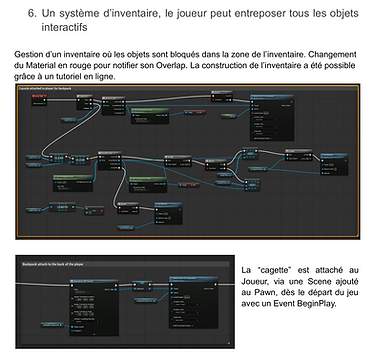
- Inventory system
- Game saving system
I challenged myself to implement the most, but due to time constraints, I settled for these system that still succeeded in giving the game a playable and fun feeling.
NARRATIVE DESIGN
With having an already built world and lore universe, I had the opportunity to focus on how I can make these parts interact with the player in an interesting way. Following the simple narrative flow proposition by Jesse Schell in his book: The Art of Game Design (2008), the narrative flow follows this structure:

Keeping in mind this flow, I introduced the dialogs, quests, action sequences and final resolution in this pattern throughout the prototype. Then, I wrote the branching narrative to give to the player control over what questions is asked and which information to gather. The Branching narratives document is available in the Appendix, as seen below:


UNREAL ENGINE 5.7 PROGRAMMING
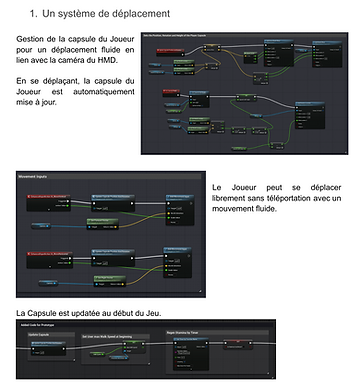
Through intense learning via my trainings and Youtube video tutorials, I successfully implemented more than 15+ gameplay systems that are linked with the Game Design Document:
- Movement system (teleportation-free)
- Health and death system
- Health regeneration through eating
- Stamina system
- Economy system
- Inventory system
- Dialog system
- Notebook system
- Enemy AI system (NPC & animals)
- NPC vs NPC system
- Patrolling system
- Saving system
- Voice-over system
- Sound design system
- Interactable objects system
Detailled demonstrations are available in the Fiche technique d'un niveau in the Appendix. Only available in French.
VOICE-OVER
All recordings in the Prototype were made using a micro and the Dictaphone app on Windows. Helped by my past experiences in open-mic and other various public speaking events, I gave the NPCs a voice with intonations and feels. Afterwards, I applied a voice modifier effects on 4 out of 5 voiced NPC.
Although the voice modifiers give an AI feeling, all recordings were made by me.
DOCUMENTATION BUILDING
Keeping in mind that video game development is a team effort, I documented every progress and kept a clean Blueprint table. The documents can be found in the Appendix.
SOUND EDITING
Sound is an important part of the immersion. I decided to include sound design very early in the build for immersion. The process was fairly easy: finding the sound effect on free distribution platforms, modifying it to extract a MP3 version and implementing it inside the UE5 prototype through content assets and Blueprint.
VIDEO EDITING
Having video editing experiences from publishing on Youtube and Twitch, editing the presentation video was easily done.
CHALLENGES OVERCOME
TIME CONSTRAINTS
One of my biggest challenges was the time constraint put on building the Prototype. The latest version was to be submitted to the Gaming Campus as a final exam to be granted the certification. Over a 7-months long training, we had to produce first the Game Design Document and a Level Design Document, as well as a working prototype to demonstrate our skills. All these documents and the prototype demo had to be submitted the 29th of March, 2026.
Between January and March 2026 we had classes for both Unity (first) and Unreal Engine (second). During the trainings on UE5, I started the prototype in mid-February and finished it in mid-March, in time for the final submission.
NO PRIOR EXPERIENCES WITH UE5
During my training, I had the opportunity to learn both Unity and Unreal Engine 5.7. While I had no prior knowledge of programming (except in Excel VBA), I decided to create my game in UE5 for multiple reasons: VR games seem to be better responding on Unreal Engine (ex: Into the Radius 1), the Blueprints facilitate the learning curve and UE5 seems to have better control over the graphics.
Helped by the Game Design Document and the Level Design Document I had produced, the process went step-by-step. Along the way, I learned how to implement the game mechanics I had envisionned for 2083 VR. This constant learning through my formation, books and Youtube tutorials led me to developing over 15+ gameplay systems that are intricate to the base experience I wished the player to feel during a game session.
To really achieve the vision of the ambitious game concept, more mechanics will have to be implemented but, due to time constraints, I postponed these implementations and feel satisfied, for now, of this Version 1.0.
Below are some examples of these systems, gathered from the Fiche technique d'un niveau located in the Appendix:


DIFFERENT ITERATIONS
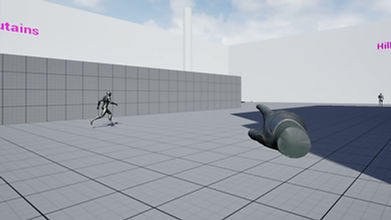
To achieve the Version 1.0 (Prototype) of 2083 VR, I made a few iterations of the game. During my first try, I started by creating the map with textures, believing it would help me design the narrative flow. However, this first version was laggy and did not helped me in implementing mechanics.
So, I started anew and kept the original main frame of the map, as the flow was good. With it, I built a Version 0.1 without any textures and adding based character meshes. This allowed me to focus on gameplay mechanics:
As soon as I had all the mechanics in place, I started using free FAB meshes to build the third iteration of the game. There, I put textures, sounds and voice-over to make it feel alive. This third version is the final one, where a player can really get immersed in this first level, serving as a Tutorial:

APPENDIX


The Game Design Document has been produced and details in a 151 pages document the intricated game and narrative mechanics of 2083 VR.
The GDD is not available on this website, but a preview is available on demand.

The Level Design Document is a multipages document that details the different maps and levels in 2083 VR.
The LDD is not available on this website.